
Top Signs You Need Garage Door Service – Don’t Ignore These
A garage door rarely fails without warning. It tells you something’s wrong through sound, speed and balance long before a component snaps, and most homeowners normalize those signals over months until the day it quits. The trouble is that a door taking two seconds longer to open than it did last winter isn’t just slower – it’s a motor working against resistance that wears the opener’s drive system down with every cycle. Here’s how to read what your door is telling you.
If you’d rather not climb a ladder and test things yourself, call (855) 305-8770. We answer 24/7.
The 30-Second Balance Test That Tells You the Most
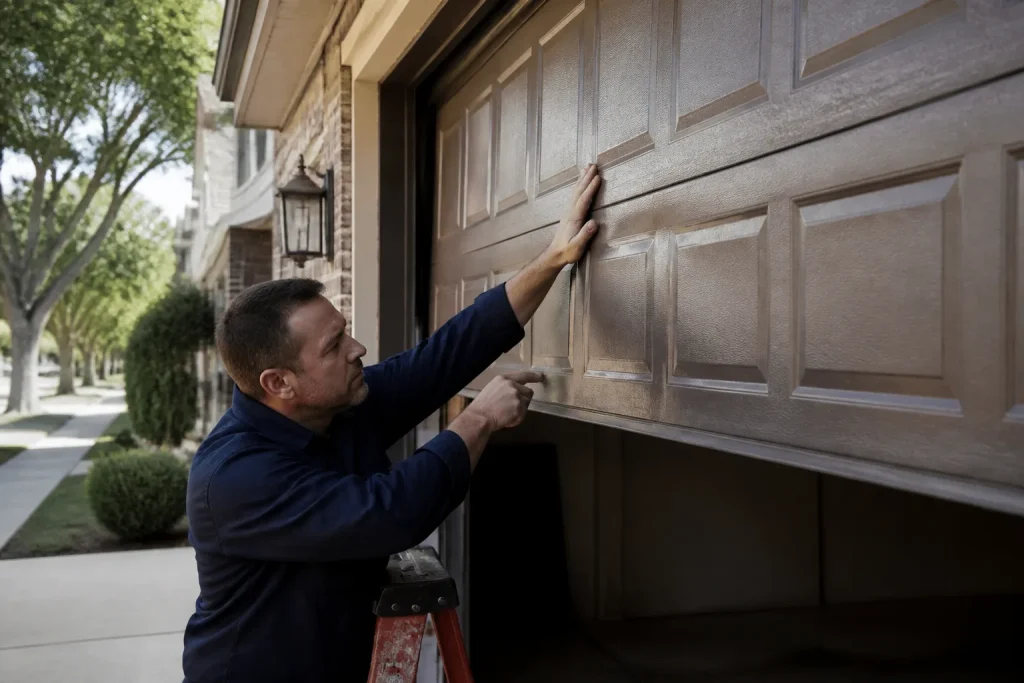
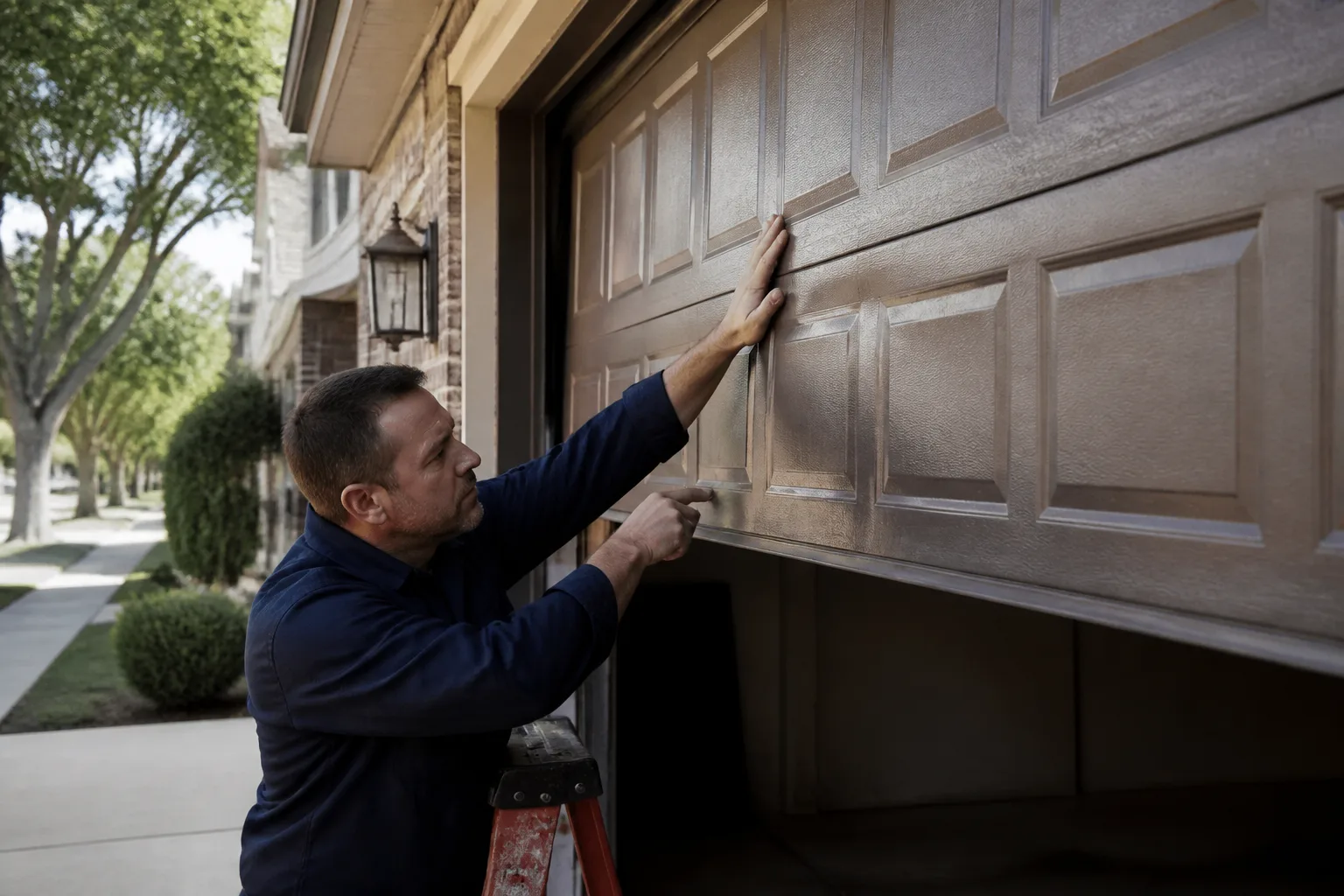
Pull the release handle to disconnect the opener, lift the door halfway by hand, and let go. A healthy door holds that position. If it drifts down or springs back up on its own, the springs are out of balance with the door’s weight – and that’s the single most revealing thing you can check.
Here’s why it matters. Torsion and extension springs carry the full weight of the door, which on a typical single-car door runs well over a hundred pounds. When a spring weakens, the opener has to lift weight the springs should be carrying. The door still opens, so nothing seems wrong, but the opener’s motor and drive gear are now doing work they weren’t built for.
What the result tells you about spring wear:
- Door won’t hold at halfway and falls fast: springs have lost significant tension. This is a stop-using-it signal.
- Door rises on its own from halfway: springs are over-tensioned or mismatched. Also a stop-using-it signal.
- Door holds on one side but sags on the other: one spring in a pair has failed. A matched pair is almost always replaced together.
- Door holds but feels heavy when you lift it: early spring fatigue, worth a professional look before it goes further.
Springs store hundreds of pounds of tension, and a failed one releases it instantly. This is not a DIY repair – leave the testing at the halfway-and-release stage and let a technician handle anything past it.
What the Sounds Are Actually Telling You
Every unusual noise points at a specific component. Learning to tell them apart saves you from guessing – and from waiting on a sound that means something is about to let go.
- Scraping: metal on metal, usually the door panel or rollers rubbing a track that’s bent, out of alignment or missing lubrication. Left alone, tracks wear grooves into the rollers and the door starts to bind.
- Popping or a loud bang: a torsion spring snapping. If you hear one sharp pop and the door suddenly won’t lift, that’s the spring. Stop using the opener.
- Grinding: often the opener’s gear and sprocket assembly, or worn bearings in the rollers. Genie and LiftMaster units both develop a distinct grind when the drive gear wears.
- Rattling that’s gotten worse: loose hinges, brackets or roller stems working free from vibration.
- A hum with no movement: the opener’s motor runs but the door doesn’t. Could be a stripped gear, a dead capacitor or a door that’s too heavy for the opener to lift – which loops back to the balance test above.
One sound worth naming in Evanston: doors that sit against a cold north-facing wall in January tend to scrape louder as the metal track contracts. If that noise disappears in April, see the seasonal section below – it hasn’t fixed itself.
Visible Cable Fraying Is an Emergency, Not a Watch Item
Look at the cables running along each side of the door. If you see strands separating, a fuzzy texture, kinks or rust blooming along the length, that cable is on borrowed time. This is not a “keep an eye on it” situation – it’s a call-today situation.
The physics explain why. A garage door cable is made of many thin steel strands wound together. Once some strands break, the load shifts onto the remaining ones, which now carry more weight than they were rated for. The failure accelerates. Unlike a worn belt that slips and warns you, a frayed cable typically lets go all at once, and when it does the door can drop or rack sideways in the track.
What to do if you spot it:
- Stop running the door, by opener or by hand.
- Keep people and vehicles clear of the doorway.
- Don’t try to cut, retie or adjust the cable.
- Call for service. A trained technician replaces cables with the tension properly released first.
Cables are part of the same high-tension system as the springs. Treat any visible damage there the way you’d treat a brake line with a bulge in it.
When the Opener Starts Behaving Differently
Openers rarely die cleanly. They drift first. The changes below usually show up weeks before a total failure, and catching them early is the difference between a sensor adjustment and a new unit.
- The door reverses on its own partway down. The safety sensors are misaligned, dirty, or the logic board is misreading them. A door that reverses at random is a door that could crush something it shouldn’t.
- The door closes but won’t reopen on the remote. Often a signal issue or a failing wall control, not the motor itself.
- Response time has slowed. A pause between pressing the button and the door moving suggests a weakening capacitor or a drive system fighting resistance from the door itself.
- Smart features drop offline. If your myQ or Wi-Fi-connected opener keeps losing its connection, the board or the module may be failing, not your router.
We work on the brand already in your garage, including LiftMaster, Chamberlain, Genie, Clopay, Amarr, Wayne Dalton, Craftsman and Raynor. Knowing the specific hardware means faster diagnosis. If your unit needs attention, our garage door opener repair team handles both legacy and modern connected systems.
The Seasonal Trap: Problems That “Go Away” in Spring
Some garage door problems show up in November, seem to resolve themselves by April, and return worse the following winter. That pattern isn’t a coincidence – it’s temperature masking a real failure.
Cold contracts metal. Tracks narrow, springs stiffen, and a door that’s slightly out of balance becomes noticeably harder to lift. In an Evanston January, a marginal spring suddenly can’t carry the door, the opener strains, and the door sounds terrible. Come spring, the metal expands, the spring’s behavior improves, and the problem seems gone. It wasn’t gone. The spring lost tension permanently, and the opener took months of extra wear.
Other seasonal signals to watch for:
- A door that only scrapes in cold weather suggests a track alignment issue that gets worse as the metal contracts.
- An opener that only strains in winter means the door is heavier than the springs can compensate for.
- Frost heave under the concrete apron can push the bottom seal out of contact, tripping the safety sensors.
- Lubricant thickens in cold weather, so a door that’s overdue for service gets noticeably sluggish below freezing.
If a problem has returned two winters in a row, it’s not weather. It’s a worn component. When your garage door repair needs to happen, our technicians have up to 15 years of experience sorting temperature-masked issues from real failures.
When to Call a Pro
Any of the following means it’s time to stop using the door and get a technician out:
- The door won’t hold at halfway, or falls or rises on its own
- A spring has visibly snapped, or you heard a loud pop followed by no lift
- Cables show fraying, kinks or rust
- The door reverses at random, or the opener hums without moving the door
- The door has come off one track or is visibly crooked
- You’ve had the same problem return two winters running
Spring work in particular carries serious injury risk. When your garage door spring repair is needed, our technicians use proper tooling and the right training for the tension involved – this is one repair where doing it yourself is genuinely dangerous.
Related services in Evanston
Beyond diagnostics, we handle opener electronics, panel and track repair, and full door installation, including Clopay, Amarr and Wayne Dalton doors. One call covers the whole job, and you can read about everything we do on our Evanston Garage Door Repair Pros page.
The Bottom Line
Your garage door tells you what’s failing before it fails – through a slower lift, a new sound, a balance test that doesn’t hold, or a behavior change in the opener. The most useful thing you can do is run the 30-second balance test and listen. The second most useful thing is to act on what you find instead of waiting for the next cold snap to make the decision for you.
If you’re in Evanston and need help, Evanston Garage Door Repair Pros offers free estimates – call (855) 305-8770. We answer 24/7. Fast dispatch from 7am to 7pm, Sunday through Friday. The price is quoted and agreed before any work starts, so you’ll know the cost before we begin.
Written by the team at Evanston Garage Door Repair Pros.
Frequently Asked Questions
A door that won’t hold its position at the halfway point when you lift it by hand. That’s the earliest reliable sign of spring wear. You may also notice the door feels heavy when lifted manually, or that the opener strains and sounds louder than it used to. Call (855) 305-8770 for an exact quote – estimates are free.
No. Stop using the door completely, by opener or by hand. A frayed cable carries the door’s full weight on fewer strands than it was built for, and it typically fails all at once rather than gradually. Get a technician out before the door moves again.
Yes. Cold weather contracts metal and stiffens springs, which exposes weaknesses that improve in warmer months. If a problem returns each winter, the underlying component is worn and will continue to worsen. It’s worth a look now rather than after it fails.
Repair costs depend on the component – spring, cable, opener or track work all price differently. We give a free estimate and quote the job in writing before any work starts, so the agreed price is the price. Call (855) 305-8770 for an exact quote – estimates are free.
Need Garage Door Help?
Call Evanston Garage Door Repair Pros - the local pro we connect you with is licensed and insured, here with fast help in Evanston.
(855) 305-8770